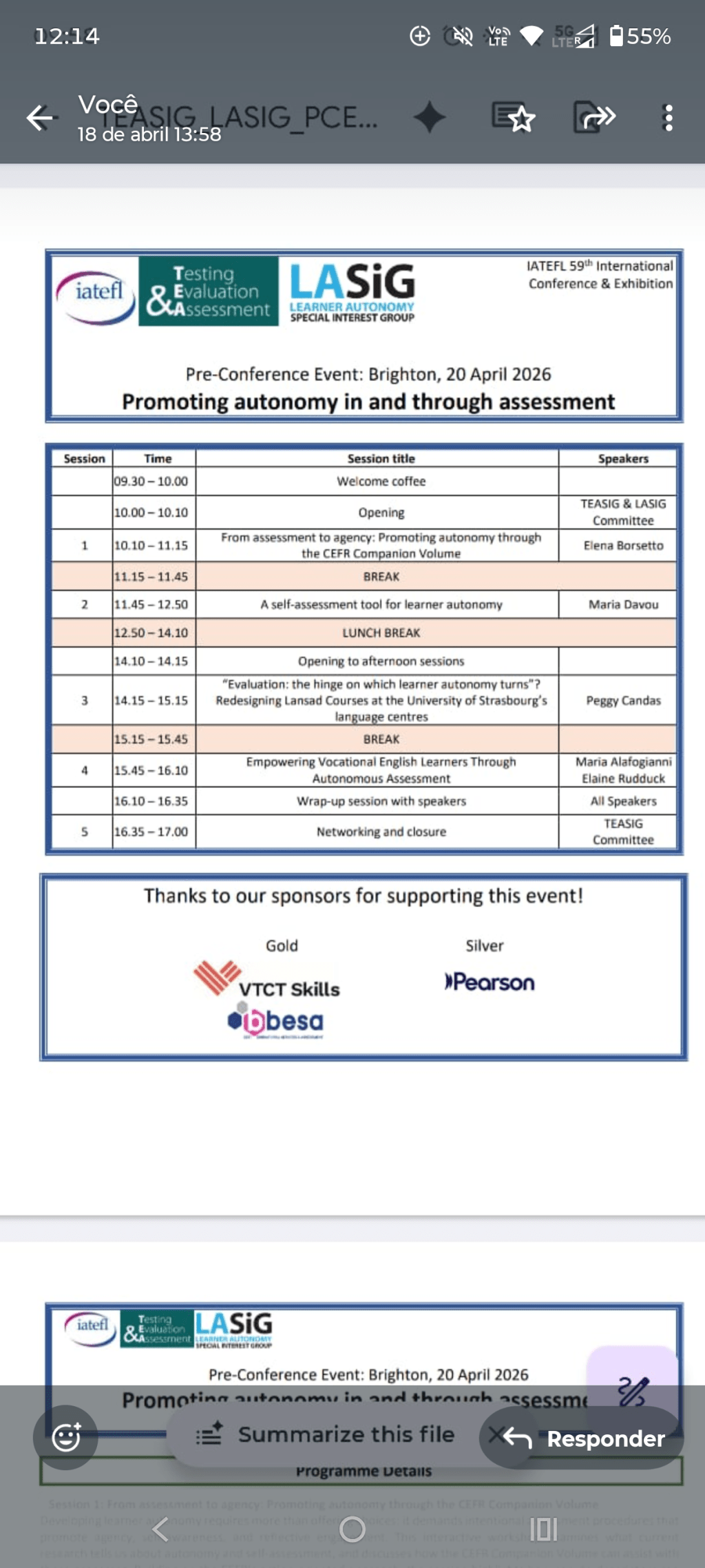
Learner Autonomy (LA) and Testing, Evaluation, and Assessment (TEA) SIGs Pre-Conference Event
Today we attended four sessions related to the intersection between LA and TEA. All sessions focused on this intersection in their own ways but all of them seemed to converge on certain topics such as performance/task-based assessment, formative assessment, self-assessment, and journaling.
This conversion on journaling really interested me as I feel it would fit a TBLT+Dogme-based course (such as one using the ETRER framework) assessed through portfolios, not quizzes or tests.
It is also interesting to note that all talks made some form of mention of task-based approaches to ELT. In my opinion, this signals a potential realization that coursebook-driven ELT, with a synthetic, atomized, linear syllabus is not a good match to learner autonomy (as nothing is decided by the learner) or formative assessment (as units and lessons are pre-defined and most courses must ‘press on’ regardless of learner’s performance).
By the end of the PCE, during the Q&A moment with all speakers, an attendee asked whether autonomous assessment would be possible with high stakes exams, such as the IELTS, Cambridge Main Suite etc. The speakers answered saying that it was unlikely since there are massive political and economic interests involved in high stakes exams, not only pedagogical interests.
I raised the issue of the need for decolonization of the CEFR and mentioned the work of Quevedo-Camargo, a professor at Universidade de Brasília, who was working on a Brazilian CEFR. To which a major publisher representative argued to be counterproductive, as having multiple standards would be confusing. He called for a ‘unification of standards’ under the CEFR.
Obviously, we disagree with this position — one we argue to be another attempt at colonization through external, European regulation. Sai pra lá.
At ELT in Brazil we stand for language education that is independent of European or American institutions, and we support initiatives from the Global South to claim the English language as a lingua franca, and no longer a foreign language.
Key words: task-based assessment, assessment for learning, journals, decolonization
See you tomorrow for another report on IATEFL 🖤


 ELT in Brazil
Leave a reply to Anonymous Cancel reply