
We are back in Brazil now, and the conference is over. I couldn’t keep up with my reports and conference events — I sincerely don’t know how Sandy does it, wow! This report will be, then, slightly different from the first two. This is a report in hindsight, kind of like a delayed post-test treatment report to assess how much of the conference sessions really stayed with me and how much my notes actually help this process. The pictures you see below are the notes I scribbled during the sessions. They include some of the speaker’s points, some of my comments and spelling mistakes.
We attended seven sessions in total, three of which will be commented on here: Richard Chinn and Danny Norrington-Davies’ plenary on emergent language, Scott Thornbury’s session on the state of ELT, and Neil McCutcheon’s session on how not to teach upside-down.
Emergent language: how we see it and what it can be
Plenary session by Richard Chinn and Danny Norrington-Davies
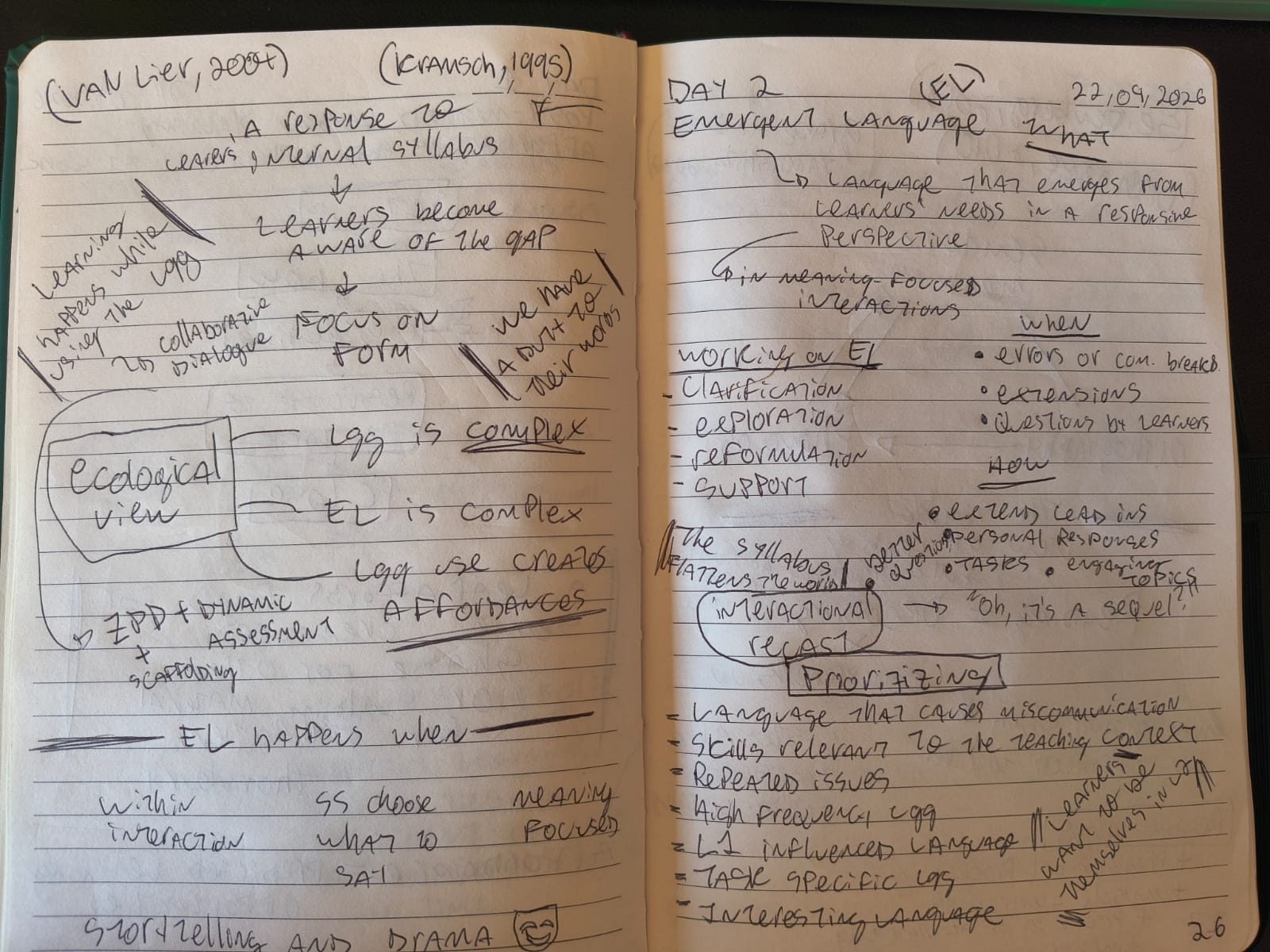
This was a brilliant way to start the best day of the conference, in my opinion. I found it refreshing to attend a session on the main stage advocating for respect to the learner’s internal syllabus, their stage of development in developmental sequences, and for an ELT that happens while learners use the language, not before to subsequently use it. The speakers defined emergent language (EL), explored different ways of working with it (clarification, exploration, reformulation, support) and when to target it (communication breakdowns, extensions, and when learners ask questions).
Richard and Danny said that EL work should be done as a response to the learner’s internal syllabus when involved in meaning-focused, interactive tasks where learners choose what and how to say. When engaged in this kind of task, learners will become aware of their gaps, and the teacher can focus on form (notice the singular use) and help build on learners’ developing interlanguage system. This closely aligns with our current research focus and practice. When working with the ETRER framework, a combination of Dogme and TBLT, all of the work that is done on language is reactive and based on learners’ immediate needs.
A final takeaway from this talk is the speakers’ suggestion on how to prioritize the EL to focus on. They recommend targeting:
- Language that causes miscommunication
- Skills relevant to the teaching context
- Repeated issues
- High-frequency language
- L1-influenced language
- Task-specific language
- Interesting language
3rd person ‘s’ and the state of ELT
Auditorium session by Scott Thornbury
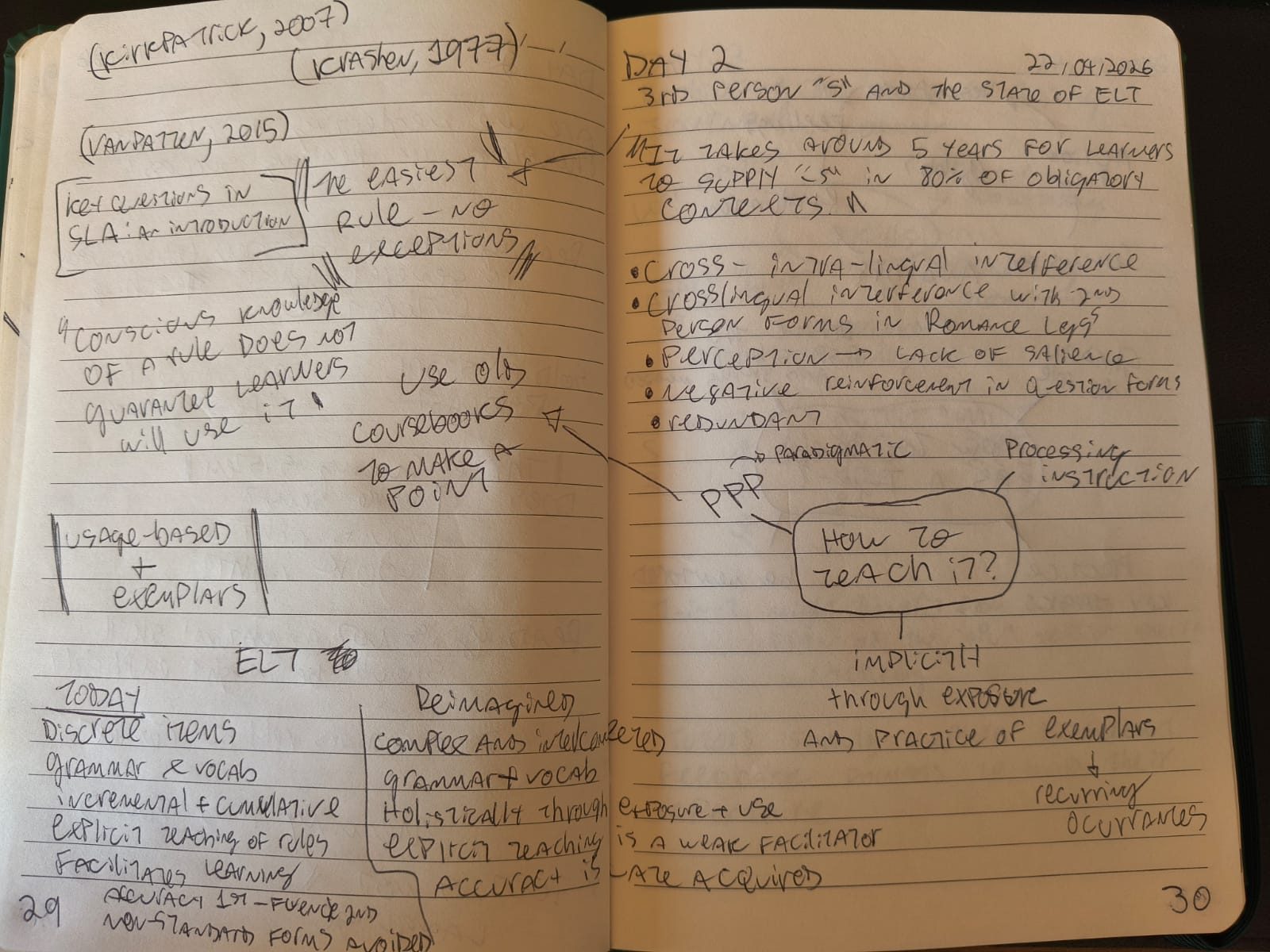
Scott’s session was a perfect follow-up for Danny and Richard’s plenary. Scott spent some time talking about the origins of the 3rd person ‘s’ and the challenges involved in teaching such a simple piece of grammar. He mentioned the fact that the 3rd person ‘s’ is “the easiest rule” and that there are “no exceptions” to its use. However, learners still take around 5 years to supply it in 80% of obligatory contexts. In my opinion, this is a perfect analogy — for those who were attentive enough (or am I reading too much between the lines?) — for how inefficient PPP-based models of instruction are. If such an easy, exception-free piece of grammar takes this long to be acquired through direct instruction, it might be the case for a different perspective on ELT. One that does not rely on the explicit instruction of superficial and psychologically non-existent grammar ‘rules’ (see VanPatten’s The Nature of Language) and the attempt to proceduralize these through rounds and rounds of behaviorist habit-forming practice drills.
Scott wrapped up his talk by drawing a parallel between ELT today and how it could be:
| ELT today | How it could be |
| Discrete items | Complex and interconnected |
| Grammar x Vocabulary | Grammar + Vocabulary |
| Incremental and cumulative | Holistically through exposure and use |
| Explicit teaching of rules facilitates learning | Explicit teaching is a weak facilitator |
| Accuracy first, fluency later | Accuracy is late acquired |
| Non-standard forms are to be avoided | Non-standard forms are inevitable |
The column on the right is in perfect adherence to our pedagogy at ELT in Brazil and our current research and practice. On the other hand, the column on the left seems to be the spinal cord for many (most? all?) general English coursebooks out there. I had a conversation some time ago with a close friend of mine who makes their living through writing coursebooks and coursebook peripherals, he joked “Bruno wants us all out of a job”. And that’s certainly not the case. I wonder, however, if there is a path forward with coursebooks. Why is it that they all have to follow the same principles and approaches to ELT? Why is it that they all have to abide by the ‘ELT today’ column? Why is it that when we talk about materials writing, the conversation seems to unequivocally gravitate around coursebooks? Can materials writing exist independently of coursebook-driven ELT?
How not to teach upside-down
Session by Neil McCutcheon
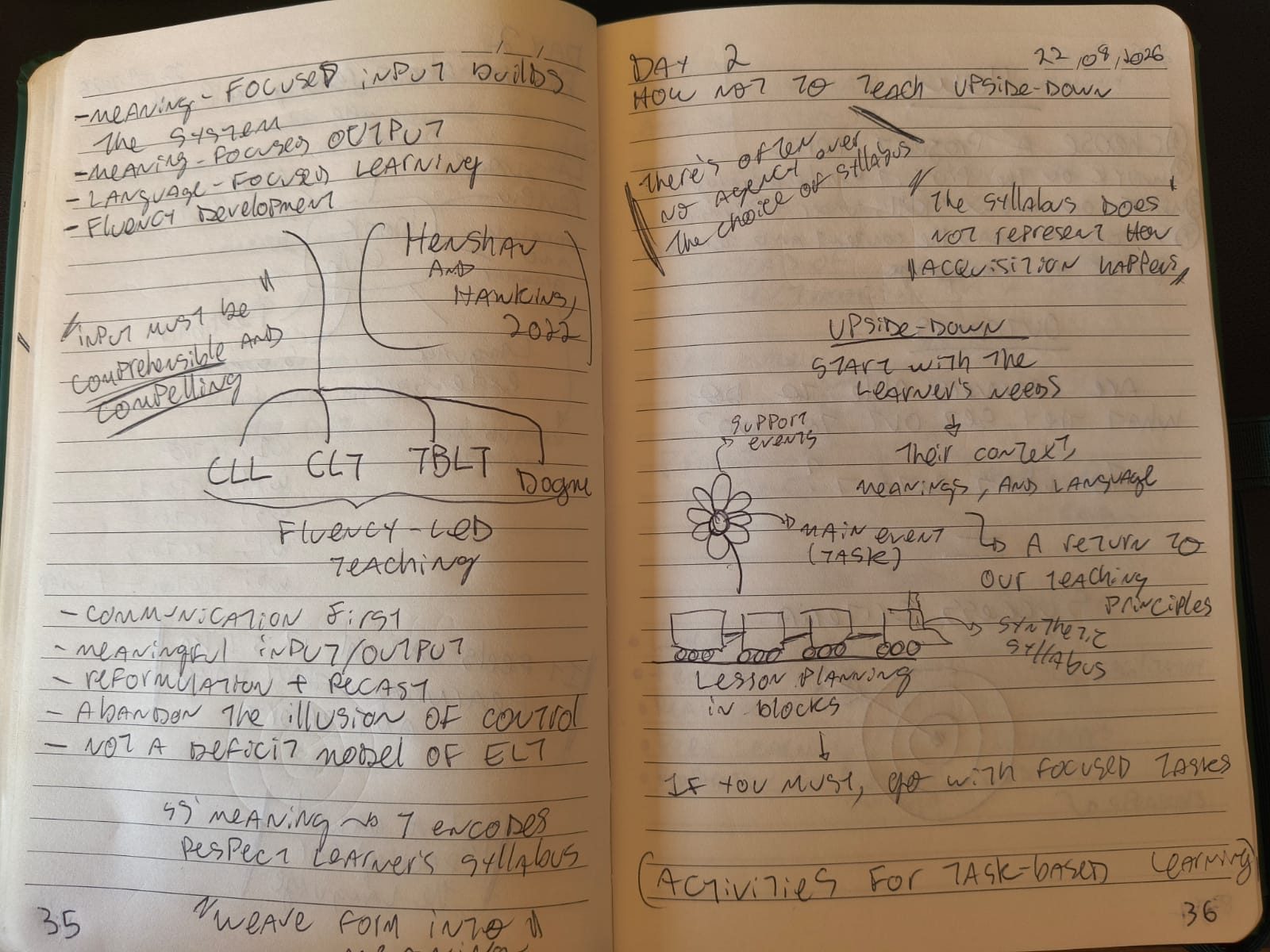
Neil’s session provided an interesting view on the synthetic grammar syllabus. Neil began his talk by saying that the syllabus does not represent how acquisition happens (a fact in SLA, see Spada and Lightbown’s How Languages are Learned, for example) and that “there’s often no agency over the choice of syllabus” — a hedged way of saying that there is no student-centeredness in a synthetic syllabus-based course. Echoing the ethos from the two previous sessions, McCutcheon advocated for fluency-led teaching based on the understanding that meaning-focused input builds the interlanguage system of our learners, that this input must be comprehensible (Krashen’s i+1) and compelling, and that meaning-focused input helps them make sense of it.
Neil talked about how effective lessons should put communication first, provide opportunities for meaningful input and output, and help learners develop their language through reformulation and recasts — the teacher helps the learners encode their meaning by “weaving form into meaning”.
Finally, Neil brought this perspective on different lesson planning visual analogies. He said that, generally, lesson planning takes the format of blocks in sequence (see the train above), where one stage feeds the next linearly. For instance, in a PPP lesson, you have each P being followed by another P in blocks. One stage dependent on the other. In the flower format (cute, right?) the main event of the lesson is the task, and everything else ‘blooms’ from it (I know, I’ll stop with the clichés).
It is interesting, however, how this perspective of lesson planning makes a lot of sense to me. When I’m planning my lessons, most of the work done is focused on deciding the task to be worked on in class. The moment this decision has been made (usually in class with the learners, but sometimes during course design), the lesson is ready. Everything else just fits naturally as supporting acts around the main event.
On a final note, I feel IATEFL is a couple of steps ahead, in terms of SLA adherence, of the BRAZ-TESOL conferences I’m used to. Perhaps due to its size and number of sessions, it is possible to find speakers talking about ELT that is not coursebook-driven and that advocate for progress in our field. May the flickering flame of progress shine bright.
Keywords: emergent language, meaning-focused, task, holistic, implicit learning/teaching, synthetic syllabus

 ELT in Brazil
Leave a comment